
GENERAL

Collective Effervescence

The Magic That Happens When We Play Together

By Ron Goldenberg

If you've ever walked out of a West Island New Horizons Band rehearsal feeling a little lighter, a little happier, and somehow more energized than when you arrived, you're not imagining things.

Sociologists have a term for it: collective effervescence.

It sounds complicated, but the idea is simple. Collective effervescence is the feeling that occurs when people come together, share a common purpose, and become part of something larger than themselves. It is that powerful sense of connection, energy, and belonging that emerges when a group experiences something together.

For us, it happens every week.

It begins quietly. Musicians arrive carrying instrument cases, greeting friends, finding their seats, and chatting about their week. Then the conductor raises the baton, the first notes sound, and something remarkable begins to happen.

Individual players stop thinking only about themselves. We listen. We adjust. We breathe together. We blend our sounds into a single musical voice.

A flute line supports the clarinets. The trumpets lift the melody. The saxophones add warmth. The low brass and low reeds provide the foundation that holds everything together. What starts out as individual musicians becomes one ensemble.

That transformation is collective effervescence in action.

The phenomenon helps explain why community bands are about so much more than music. Research has shown that making music with others can strengthen social bonds, reduce feelings of isolation, improve mental well-being, and create a strong sense of belonging.

Many members of the West Island New Horizons Band joined for musical reasons. Some wanted to improve their playing. Others wanted to return to an instrument after years—or even decades—away. Yet ask members why they stay, and the answers often go beyond music.

They stay because of the friendships.

They stay because of the laughter.

They stay because of concert band on Thursday evenings and Monday jazz band rehearsals have become an important part of their lives.

They stay because there is something deeply satisfying about creating music together.

Anyone can play notes alone in a practice room. But when fifty musicians work together to create something none of them could produce individually, a different kind of magic emerges.

Perhaps that is the true secret of the West Island New Horizons Band.

Yes, we are learning music.

Yes, we are improving our skills.

But we are also building something less tangible and equally valuable: a community.

And every time the final chord of a rehearsal rings through the room and smiles appear across the band, we experience a little spark of that collective effervescence—the joy of being part of something larger than ourselves.

That is one of the reasons we keep coming back.

And that is why making music together never gets old.

________________________________________

The West Island New Horizons Band welcomes musicians of all levels, whether you are picking up an instrument for the first time or returning after many years away. Come experience the music, the friendships, and perhaps a little collective effervescence of your own.
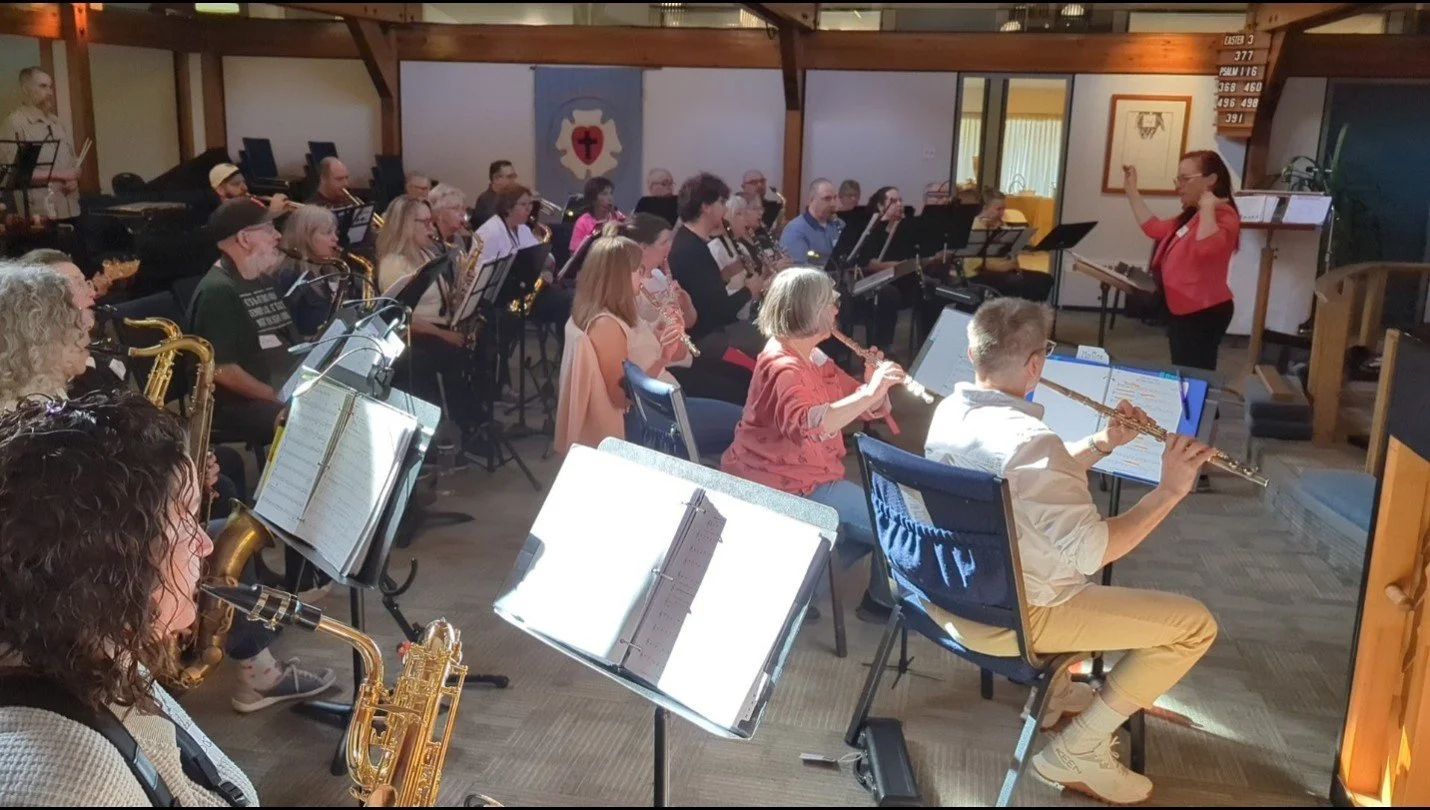
Collective effervescence in action: 40 musicians, one sound. The West Island and the Cornwall New Horizons Bands joint rehearsal.

Band Is Cheaper Than Therapy (And Probably More Fun)

by Ron Goldenberg

There’s something about playing music with other people that changes your mood almost immediately.

You can arrive at rehearsal tired, stressed, distracted, or frustrated after a long day. Then the conductor counts off the first piece, and for the next two hours your brain is focused on something completely different.

Breathing. Listening. Counting. Playing.

Everything else fades into the background for a while.

That’s one reason so many people describe band as a kind of therapy. Not because it solves every problem—but because it gives your mind a break from carrying them around constantly.

Community bands also provide something many adults quietly struggle to find: connection.

Life gets busy. People retire, move, work from home, or drift out of social circles. Weekly rehearsals create routine, familiarity, and shared purpose. You see the same faces. You laugh at the same rehearsal mishaps. You work toward something together.

That matters more than we sometimes realize.

There’s also the physical side of music-making. Controlled breathing reduces tension. Concentration improves focus. Learning new music keeps the brain active and engaged. Even difficult rehearsals leave you with a sense of accomplishment afterward.

And unlike many hobbies, band gives something back immediately. You leave rehearsals feeling lighter, more energized, and often happier than when you arrived.

Not bad for a few hours with a music stand and a slightly overused pencil.

Of course, community band is not actual therapy, and nobody expects rehearsals to solve life’s problems. But music has a remarkable way of helping people reconnect—with themselves and with others.

And compared to many activities these days, it’s also relatively affordable.

So yes—band may actually be cheaper than therapy.

And for many of us, it’s definitely more fun.

Why Showing Up Matters More Than Talent

By Ron Goldenderg

Every community band has strong players.

But the people who truly make the band successful usually aren’t the most talented ones.

They’re the ones who show up.

Consistent attendance may not sound glamorous, but it’s one of the most important ingredients in any ensemble. Bands improve when people are there regularly - learning the music together, building confidence together, and developing trust within the group.

A talented musician who appears once every few weeks can only contribute so much. A steady player who comes every rehearsal becomes part of the foundation.

Showing up matters because ensemble playing is a team activity. The clarinets need to hear the saxes. The brass need to lock into the rhythm section. Everyone needs to learn the conductor’s style and the shape of the music together. That only happens over time.

There’s also another side to it.

When you attend regularly, you become part of the social fabric of the band. People notice when you’re there. They miss you when you’re not. Friendships form. Rehearsals become something you look forward to - not just because of the music, but because of the people.

And here’s the encouraging part: consistency beats perfection.

You do not need to be the strongest player in the room to have value. You do not need flawless technique or years of experience. If you come prepared, give your best effort, and keep showing up, you will improve naturally over time.

Most community bands are not built on virtuosos.

They’re built on dependable people who love music enough to keep coming back every week.

And honestly, that’s far more important.

Music Listening Slashes Dementia Risk 39%

By Ron Goldenberg

A comprehensive study involving elderly participants has demonstrated that consistent music engagement significantly reduces dementia incidence in adults over 70 years. The research analyzed data from the ASPirin in Reducing Events in the Elderly (ASPREE) longitudinal cohort study.

Key Points:

  • Habitual music listening correlates with 39% decreased dementia risk and 17% reduced cognitive impairment incidence
  • Musical instrument proficiency demonstrates 35% dementia risk reduction among elderly participants
  • Combined music activities yield 33% dementia risk decrease and 22% cognitive impairment reduction

Why It Matters:

These findings establish music-based interventions as accessible, non-pharmacological strategies for dementia prevention, offering clinicians evidence-based lifestyle modifications for cognitive health preservation.

“It’s Been a While… But So What?” — Picking Up Your Instrument Again with the West Island New Horizons Band

By Ron Goldenberg

Remember band class?

You might still hear the echoes—squeaky clarinet notes, blaring trumpet fanfares, that one kid who always played a little too loud. Maybe you played in your high school concert band, loved it, and then… life happened. Work, family, other responsibilities. The instrument went into the closet, and years—or decades—slipped by. But here’s the good news: it’s never too late to start again.

Welcome to the West Island New Horizons Band (WINHB)

We’re not a professional band. We’re not an intimidating audition-only group. We are a welcoming, fun-loving community of adults who just want to make music together—no matter how long it’s been since we last played.

Some of our members hadn’t picked up their instruments in 30 or 40 years. Others never stopped. And a few are learning something completely new! Wherever you are on your musical journey, there’s a place for you here.

What to Expect

  • No pressure. We rehearse once a week, and everyone learns at their own pace.
  • A supportive environment. Mistakes are part of the fun. We’ve all been there! Our motto is: Your best is good enough.
  • Laughter, friendship, and growth. Band is as much about community as it is about music.
  • No auditions, ever. If you have an instrument (or can get one), you’re in.

Still not sure?

You can drop in and observe a rehearsal before joining. Talk to our members, meet our conductor, and feel the vibe. Spoiler: it’s friendly, low-stress, and often includes cake or cookies.

Dust Off the Case—You Belong Here

So open that closet. Pull out the flute, the sax, the trumpet—whatever your old musical friend may be. Bring it back to life. Come play with us.

We do have a small inventory of instruments to lend to you as a transition to acquiring your own. The inventory includes: trumpets, flutes, saxophones, clarinets, tuba and trombones.

The West Island New Horizons Band is waiting for you.

Let’s make music again. Together.