
Collective Effervescence

The Magic That Happens When We Play Together

By Ron Goldenberg

If you've ever walked out of a West Island New Horizons Band rehearsal feeling a little lighter, a little happier, and somehow more energized than when you arrived, you're not imagining things.

Sociologists have a term for it: collective effervescence.

It sounds complicated, but the idea is simple. Collective effervescence is the feeling that occurs when people come together, share a common purpose, and become part of something larger than themselves. It is that powerful sense of connection, energy, and belonging that emerges when a group experiences something together.

For us, it happens every week.

It begins quietly. Musicians arrive carrying instrument cases, greeting friends, finding their seats, and chatting about their week. Then the conductor raises the baton, the first notes sound, and something remarkable begins to happen.

Individual players stop thinking only about themselves. We listen. We adjust. We breathe together. We blend our sounds into a single musical voice.

A flute line supports the clarinets. The trumpets lift the melody. The saxophones add warmth. The low brass and low reeds provide the foundation that holds everything together. What starts out as individual musicians becomes one ensemble.

That transformation is collective effervescence in action.

The phenomenon helps explain why community bands are about so much more than music. Research has shown that making music with others can strengthen social bonds, reduce feelings of isolation, improve mental well-being, and create a strong sense of belonging.

Many members of the West Island New Horizons Band joined for musical reasons. Some wanted to improve their playing. Others wanted to return to an instrument after years—or even decades—away. Yet ask members why they stay, and the answers often go beyond music.

They stay because of the friendships.

They stay because of the laughter.

They stay because of concert band on Thursday evenings and Monday jazz band rehearsals have become an important part of their lives.

They stay because there is something deeply satisfying about creating music together.

Anyone can play notes alone in a practice room. But when fifty musicians work together to create something none of them could produce individually, a different kind of magic emerges.

Perhaps that is the true secret of the West Island New Horizons Band.

Yes, we are learning music.

Yes, we are improving our skills.

But we are also building something less tangible and equally valuable: a community.

And every time the final chord of a rehearsal rings through the room and smiles appear across the band, we experience a little spark of that collective effervescence—the joy of being part of something larger than ourselves.

That is one of the reasons we keep coming back.

And that is why making music together never gets old.

________________________________________

The West Island New Horizons Band welcomes musicians of all levels, whether you are picking up an instrument for the first time or returning after many years away. Come experience the music, the friendships, and perhaps a little collective effervescence of your own.
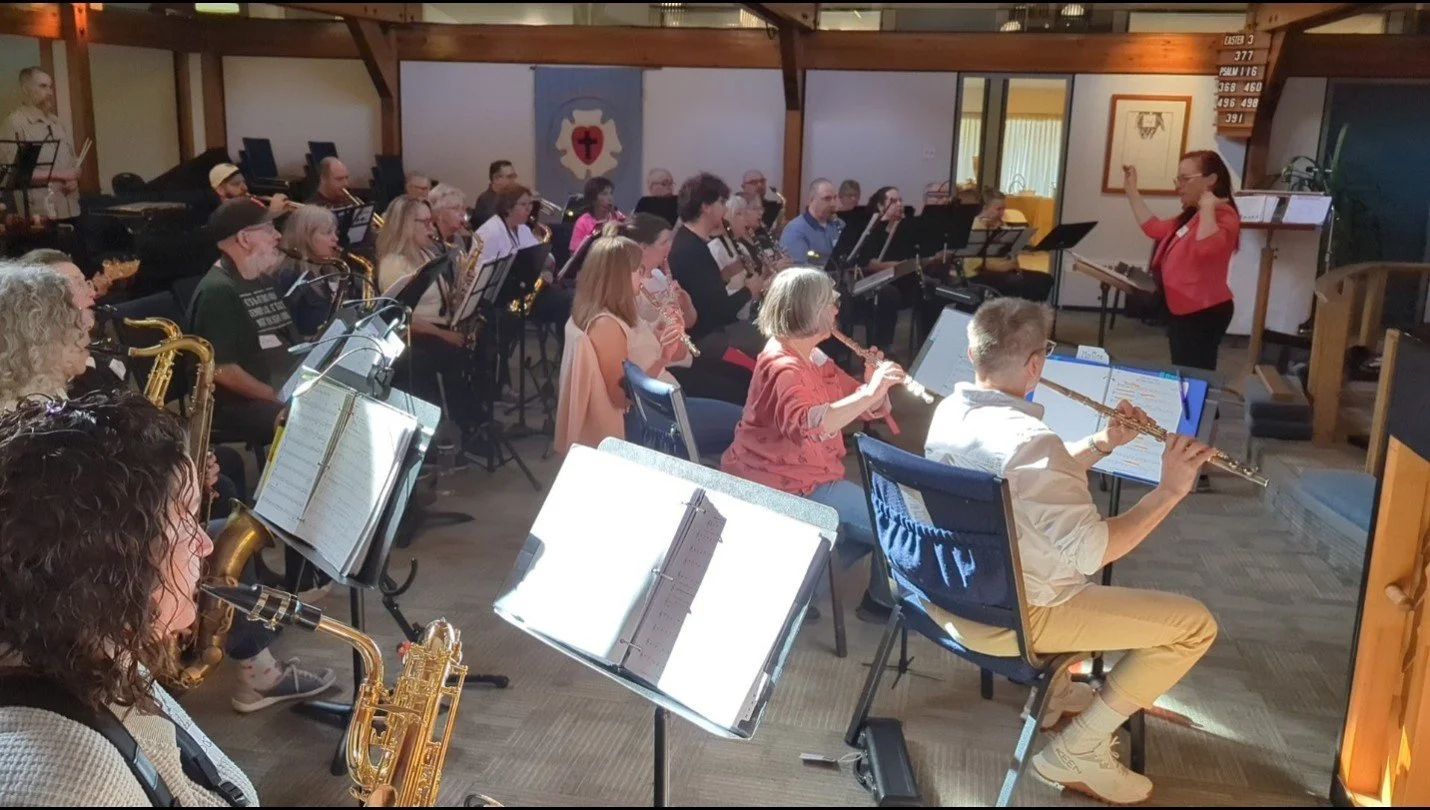
Collective effervescence in action: 40 musicians, one sound. The West Island and the Cornwall New Horizons Bands joint rehearsal.

Band Is Cheaper Than Therapy (And Probably More Fun)

by Ron Goldenberg

There’s something about playing music with other people that changes your mood almost immediately.

You can arrive at rehearsal tired, stressed, distracted, or frustrated after a long day. Then the conductor counts off the first piece, and for the next two hours your brain is focused on something completely different.

Breathing. Listening. Counting. Playing.

Everything else fades into the background for a while.

That’s one reason so many people describe band as a kind of therapy. Not because it solves every problem—but because it gives your mind a break from carrying them around constantly.

Community bands also provide something many adults quietly struggle to find: connection.

Life gets busy. People retire, move, work from home, or drift out of social circles. Weekly rehearsals create routine, familiarity, and shared purpose. You see the same faces. You laugh at the same rehearsal mishaps. You work toward something together.

That matters more than we sometimes realize.

There’s also the physical side of music-making. Controlled breathing reduces tension. Concentration improves focus. Learning new music keeps the brain active and engaged. Even difficult rehearsals leave you with a sense of accomplishment afterward.

And unlike many hobbies, band gives something back immediately. You leave rehearsals feeling lighter, more energized, and often happier than when you arrived.

Not bad for a few hours with a music stand and a slightly overused pencil.

Of course, community band is not actual therapy, and nobody expects rehearsals to solve life’s problems. But music has a remarkable way of helping people reconnect—with themselves and with others.

And compared to many activities these days, it’s also relatively affordable.

So yes—band may actually be cheaper than therapy.

And for many of us, it’s definitely more fun.

Why Showing Up Matters More Than Talent

By Ron Goldenderg

Every community band has strong players.

But the people who truly make the band successful usually aren’t the most talented ones.

They’re the ones who show up.

Consistent attendance may not sound glamorous, but it’s one of the most important ingredients in any ensemble. Bands improve when people are there regularly - learning the music together, building confidence together, and developing trust within the group.

A talented musician who appears once every few weeks can only contribute so much. A steady player who comes every rehearsal becomes part of the foundation.

Showing up matters because ensemble playing is a team activity. The clarinets need to hear the saxes. The brass need to lock into the rhythm section. Everyone needs to learn the conductor’s style and the shape of the music together. That only happens over time.

There’s also another side to it.

When you attend regularly, you become part of the social fabric of the band. People notice when you’re there. They miss you when you’re not. Friendships form. Rehearsals become something you look forward to - not just because of the music, but because of the people.

And here’s the encouraging part: consistency beats perfection.

You do not need to be the strongest player in the room to have value. You do not need flawless technique or years of experience. If you come prepared, give your best effort, and keep showing up, you will improve naturally over time.

Most community bands are not built on virtuosos.

They’re built on dependable people who love music enough to keep coming back every week.

And honestly, that’s far more important.

From Wrong Notes to Great Music: Why Mistakes Matter

by Ron Goldenberg

Let’s get one thing out of the way: mistakes are part of the deal. In fact, if you’re not making mistakes, you’re probably not pushing yourself enough.

Every rehearsal has them—missed entrances, cracked notes, wrong rhythms. It happens to beginners, and it happens to experienced players too. The difference is how you respond to them.

In a community band, mistakes aren’t failures. They’re signals. They tell you where to focus, what needs a bit more attention, and where the group needs to tighten up. More importantly, they remind us that we’re all human - and that music is a process, not a finished product.

Some of the best moments in rehearsal come right after something goes wrong. A section resets, everyone listens a little more closely, and suddenly the next attempt clicks. That progress - that small improvement - is where the real satisfaction lives.

There’s also something bonding about shared imperfection. When a whole section comes in a bar early and then laughs about it, it breaks tension. It makes the experience lighter, more enjoyable.

And over time, those “mistakes” become fewer and farther between—not because you avoided them, but because you worked through them.

So don’t fear the wrong notes.

Play through them. Learn from them. And keep going.

That’s how great music happens.

The First Rehearsal Nerves — And How to Get Over Them

by Ron Goldenberg

Walking into your first rehearsal can feel like the first day of school.

You don’t know where to sit. You’re not sure how good everyone else is. You wonder if you’ll keep up - or worse, stick out.

Here’s the truth: almost everyone in the room felt exactly the same way at some point.

Community bands are full of people who are returning to music after years (sometimes decades), trying something new, or just looking for a fun way to spend an evening. It’s not an audition. It’s not a competition. It’s a group of people figuring things out together.

Will you miss a note? Of course. Will you come in at the wrong time once or twice? Almost guaranteed.

And no one will care.

What they will notice is that you showed up.

The nerves usually disappear faster than you expect—often within the first rehearsal, sometimes within the first piece. By the second or third week, you’ll recognize faces, understand the flow, and start to feel like you belong.

Because you do.

So, if you’re hesitating about that first step, take it anyway. Bring your instrument, a pencil, and a willingness to try.

That’s all it takes.

Why Every Band Needs More Low Brass (Yes, You!)

By Ron Goldenberg

Let’s be honest—every community band has that one section that’s… a little thin.

And by “a little thin,” we mean: where did all the low brass go?

Trombones, tubas, euphoniums, baritone saxes—they’re the backbone of the band. They add depth, power, and that rich sound that makes the whole ensemble feel complete. Without them, something’s missing. You might not always notice it right away, but you definitely feel it.

Here’s the thing: low brass players are in demand. Always.

If you’ve ever thought about switching instruments, doubling, or trying something new, this is your moment. Many musicians who move to lower instruments find it surprisingly rewarding. The parts are often more about groove and foundation than flashy runs—and when the band sounds great, you know you helped make that happen.

There’s also something quietly satisfying about being part of the engine room. You’re not always in the spotlight, but you’re essential. And when the low end is strong, the whole band improves instantly.

So, if you’ve got a trombone in the closet, or you’re curious about trying baritone sax or euphonium, don’t overthink it. Community bands are the perfect place to experiment.

We need you. Seriously.

Music Listening Slashes Dementia Risk 39%

By Ron Goldenberg

A comprehensive study involving elderly participants has demonstrated that consistent music engagement significantly reduces dementia incidence in adults over 70 years. The research analyzed data from the ASPirin in Reducing Events in the Elderly (ASPREE) longitudinal cohort study.

Key Points:

  • Habitual music listening correlates with 39% decreased dementia risk and 17% reduced cognitive impairment incidence
  • Musical instrument proficiency demonstrates 35% dementia risk reduction among elderly participants
  • Combined music activities yield 33% dementia risk decrease and 22% cognitive impairment reduction

Why It Matters:

These findings establish music-based interventions as accessible, non-pharmacological strategies for dementia prevention, offering clinicians evidence-based lifestyle modifications for cognitive health preservation.

“It’s Been a While… But So What?” — Picking Up Your Instrument Again with the West Island New Horizons Band

By Ron Goldenberg

Remember band class?

You might still hear the echoes—squeaky clarinet notes, blaring trumpet fanfares, that one kid who always played a little too loud. Maybe you played in your high school concert band, loved it, and then… life happened. Work, family, other responsibilities. The instrument went into the closet, and years—or decades—slipped by. But here’s the good news: it’s never too late to start again.

Welcome to the West Island New Horizons Band (WINHB)

We’re not a professional band. We’re not an intimidating audition-only group. We are a welcoming, fun-loving community of adults who just want to make music together—no matter how long it’s been since we last played.

Some of our members hadn’t picked up their instruments in 30 or 40 years. Others never stopped. And a few are learning something completely new! Wherever you are on your musical journey, there’s a place for you here.

What to Expect

  • No pressure. We rehearse once a week, and everyone learns at their own pace.
  • A supportive environment. Mistakes are part of the fun. We’ve all been there! Our motto is: Your best is good enough.
  • Laughter, friendship, and growth. Band is as much about community as it is about music.
  • No auditions, ever. If you have an instrument (or can get one), you’re in.

Still not sure?

You can drop in and observe a rehearsal before joining. Talk to our members, meet our conductor, and feel the vibe. Spoiler: it’s friendly, low-stress, and often includes cake or cookies.

Dust Off the Case—You Belong Here

So open that closet. Pull out the flute, the sax, the trumpet—whatever your old musical friend may be. Bring it back to life. Come play with us.

We do have a small inventory of instruments to lend to you as a transition to acquiring your own. The inventory includes: trumpets, flutes, saxophones, clarinets, tuba and trombones.

The West Island New Horizons Band is waiting for you.

Let’s make music again. Together.

Playing in an Ensemble: The Art of Making Music Together

By CHAT RMG

Playing in an ensemble is a unique and rewarding experience that brings musicians together to create something greater than the sum of its parts. Whether you are part of a concert band, orchestra, or small chamber group, mastering the art of ensemble playing requires teamwork, listening skills, and musical discipline. Here are some key aspects of playing in an ensemble and tips to improve your experience.

  1. The Importance of Listening
    One of the most crucial skills in ensemble playing is active listening. You must be aware of the other musicians around you, matching tone, balance, and phrasing. Pay attention to the conductor and section leaders to ensure you stay in sync with the group.
  2. Following the Conductor
    The conductor is the guiding force of the ensemble, providing cues for tempo, dynamics, and expression. Maintain eye contact with the conductor as much as possible and respond to their gestures promptly.
  3. Blending and Balance
    A great ensemble performance requires musicians to blend their sounds seamlessly. Avoid overpowering others by adjusting your dynamics and tone to fit within the section and overall group.
  4. Practicing at Home
    Individual preparation is essential for ensemble success. Practice your part thoroughly before rehearsals so you can focus on group cohesion rather than just playing the notes.
  5. Communication and Teamwork
    Playing in an ensemble is all about collaboration. Work closely with fellow musicians, communicate musically and verbally when necessary, and be open to feedback to create a cohesive sound.
  6. Developing Rhythm and Timing
    A strong sense of rhythm is fundamental in ensemble playing. Use a metronome during practice and internalize the beat to stay in sync with the group. Count rests carefully and be ready to enter precisely.
  7. Expressing Emotion and Musicality
    Ensemble music is not just about playing notes—it’s about telling a story. Pay attention to phrasing, articulation, and dynamics to bring out the emotion in the music and create a compelling performance.
  8. Enjoy the Experience
    Finally, playing in an ensemble is meant to be enjoyable. Take in the experience of making music with others, appreciate the camaraderie, and celebrate the joy of performing together.

By mastering these ensemble skills, you will not only become a better musician but also contribute to creating memorable musical experiences for yourself and your audience. Keep practicing, stay engaged, and enjoy the journey of making music together!

Tips for Musicians: Enhancing Your Practice and Performance

By CHAT RMG

Playing in a community concert band is a rewarding experience, but every musician can benefit from refining their skills. Whether you're a beginner or a seasoned player, here are some valuable tips to enhance your practice and performance.

  1. Develop a Consistent Practice Routine
    Consistency is key to improvement. Set aside regular time for practice, even if it's just 20–30 minutes a day. Establishing a routine helps reinforce muscle memory and build confidence.
  2. Warm Up Properly
    Warming up before playing is essential. Start with long tones, scales, and simple exercises to get your fingers and embouchure (for wind players) ready. A good warm-up improves tone quality and reduces tension.
  3. Focus on Technique
    Work on technical exercises such as scales, arpeggios, and articulation drills. These build fluency and dexterity, making it easier to tackle challenging passages in your music.
  4. Practice with a Metronome
    A metronome helps develop a steady sense of rhythm and timing. Start slowly and gradually increase speed while maintaining accuracy.
  5. Listen to Professional Performances
    Listening to professional musicians can provide inspiration and insight into phrasing, tone, and musical expression. Try to emulate their style and dynamics in your own playing.
  6. Mark Your Music
    Use a pencil to make notes on your sheet music. Markings for dynamics, fingerings, and tricky passages can help you stay on track during rehearsals and performances.
  7. Play with Others
    Playing with a group improves ensemble skills, such as listening, blending, and following a conductor. Attend rehearsals regularly and engage with fellow musicians.
  8. Record Yourself
    Recording your practice sessions allows you to identify areas for improvement. Listen critically to your tone, rhythm, and phrasing, and make adjustments accordingly.
  9. Stay Relaxed and Have Fun
    Music should be enjoyable! Stay relaxed while playing to avoid tension and fatigue. Enjoy the process, and don't be too hard on yourself.
  10. Take Care of Your Instrument
    Regular maintenance ensures your instrument stays in top condition. Clean it properly, check for necessary repairs, and use high-quality reeds, strings, or mouthpieces as needed.

By incorporating these tips into your musical journey, you’ll continue to grow as a musician and contribute positively to your community concert band. Happy practicing!

Basic Music Theory

by Ron Goldenberg

For those of you interested in music theory I would recommend that you try the website

www.Musictheory.net

It’s not only written in an easy-to-follow format, but it is also extremely well done with examples and pictures. Topics range from notes, rests, time signatures and key signatures to intervals, chords/triads all the way to chord progressions and more complex topics. There is something for everyone at any level of experience.

And best of all …….. it is FREE!!

Spread the Word!

by Ron Goldenberg

The West Island New Horizons Band is gearing up for its fall session, which will start on September 22nd. So, dust off your instruments and register now! Invite all your friends to register too!

In addition to welcoming back current members, the band hopes to attract as many new members as possible for the new session in order to reverse the decline in membership caused in recent years by this pesky pandemic. To that end, we will be advertising in the Suburban newspaper for three consecutive weeks starting on August 24th. We have also produced a small flyer and business card that will be left in strategic locations on the West Island. These will be placed in libraries, music stores and other locations where we hope to spark the interest of new musicians. A sample of the flyer is shown below. If you would like to distribute some flyers, please let us know.

The best advertising, as always, is word of mouth. We are counting on you to spread the word! Tell your friends, family, neighbours and colleagues to join in the fun of making music together. If you can, please upload the flyer on your social media accounts to help with this effort.

The search continues for a new Music Director, but we are happy to confirm that Christian has agreed to continue as Music Director until we find a suitable replacement.

We look forward to making music together soon. Please register at www.westislandnh.com

The Goldenblog - 2021, July 24th

Standard of Excellence Book 1 and 2
Get the backing accompaniment

by Ron Goldenberg

We use the Standard of Excellence books as part of our rehearsal repertoire from time to time.

The books come with CDs that play the band part for each practice piece as a background for your instrument’s part. When you are practicing on your own it is much more beneficial and enjoyable to play along with the accompaniment.
This music is available for free online.

For Standard of Excellence Book 1 go to:
https://kjos.com/standard-of-excellence-book-1-cd-part-1-2.html

For Standard of Excellence Book 2 go to:
https://kjos.com/standard-of-excellence-book-2-cd-part-1-2.html

You must click on the AUDIO tab to access the music.

Happy practising!!!
Ron

The Goldenblog - December12th

Playing Along with a Backing Track

by Ron Goldenberg

The most pleasurable moments that I have when playing alone in the depths of my basement are when I play along with a backing track. There are several kinds of backing tracks available but the ones that I purchase usually have several instruments playing a song in which the melody is left out. I fill it in with my saxophone. For instance, I purchased the backing track for the jazz standard Misty from jazzbacks.com (approx. C$11). The download came with PDF sheet music for the lead/melody instrument for three types of instruments: a C instrument (like a flute) a Bb instrument (like a Clarinet, Tenor sax, Trumpet …) and an Eb instrument (like an Alto or Bari sax…). It also came with a backing track with piano, drums and a bass.

You get your sheet music ready put on the track and away you go. You are the lead in a quartet! Sounds awesome and is a real rush.

I would like to share this great experience with you so I have put sheet music and a backing track on a Google drive which you can access at the link below. I have included the songs Misty and the Shadow of Your Smile for your playing enjoyment.

The sheet music for Misty is missing the first 4 bars and the 4/4 time signature. The first 4 bars are a rest and you come in on beat 4 of bar 5. I included a little audio segment for those of you who need assistance with the count in. The Shadow of Your Smile also has sheet music for bass instruments in C.

Please enjoy yourself thoroughly. I would love to hear from you to know what you think and how you are enjoying it. Please email me, rongold@videotron.ca.

Here is the link.

https://drive.google.com/drive/folders/13dZMeU2r8eS6IvrvhPMTRXmo-POKNv7p?usp=sharing

Happy holidays to you and your families!

The Goldenblog - October 24th

PPE for All WINHB Band Members

by Ron Goldenberg

The Board of Directors of the West Island New Horizons Band insisted that all members of the band be protected to the fullest extent possible when we return to rehearsals. All distancing protocols will be strictly followed to ensure a safe experience. In addition, the Board authorized the purchase of PPE for every individual.

This PPE consists of a mouthpiece mask for all musicians that allows for the instrument to be played when the mask is worn. When the mouthpiece is removed the opening closes itself. Each instrument will have its own protection as well. For the brass instruments, where all the aerosols are emitted from the bell, we have purchased bell covers. For the woodwind instruments, where the aerosols escape all along the instrument, we have purchased “bags” to put over the instrument to capture the aerosols. These “bags” have holes for the hands and for a neck strap if applicable.

It is a little odd and uncomfortable to be playing this way but it in no way effects the sound of the instrument. The added protection is well worth the discomfort. The PPE is all machine washable.

The PPE will be supplied at no cost to the members and will be distributed in the next month or so as soon as we receive all of the product. This way we can all practice with the PPE to feel more comfortable when we meet as a group. We were given an opportunity by the Government to request additional funding to top up the Seniors Grant that we received in March of this year for any COVID-19 related additional expenses. The top up is not guaranteed, however, it does seem likely to happen.

As previously mentioned, we will do everything possible to allow us to play together as soon as it is wise. We believe that the PPE, though not foolproof, goes a long way to increase the safety of our wonderful group. Please see the picture below of our model playing the alto sax with the PPE.

Hope to be playing with you all soon!!!

Hope to be playing with you all soon!!!